

Written by: Dr. Ahmed Al-Ahmed, Attorney at Law
Delaware corporate law provides one of the most sophisticated and stable statutory environments for structuring mergers and acquisitions in the United States. The merger provisions contained in Sections 251 through 259 of the Delaware General Corporation Law (“DGCL”) reflect a deliberate legislative design that balances transactional flexibility with the protection of shareholder rights. This balance — between enabling efficient deal‑making and safeguarding investors whose rights are materially affected — is a defining feature of Delaware’s corporate jurisprudence and a principal reason for its dominance in U.S. M&A practice.
I. Structural Logic of Delaware’s Merger Framework
Delaware recognizes multiple statutory forms of merger, but the reverse triangular merger has become the prevailing structure in modern acquisition practice. In a reverse triangular merger, the acquiring corporation forms a wholly owned subsidiary that merges into the target corporation, leaving the target as the surviving entity. This structure is favored because it preserves the target’s contractual relationships, regulatory approvals, and operational continuity. By allowing the target to remain intact, the acquirer avoids renegotiating sensitive commercial agreements, re‑obtaining licenses, or triggering change‑of‑control provisions that could delay or jeopardize the transaction.
The legal foundation for triangular mergers was firmly established in Hariton v. Arco Electronics, Inc., 188 A.2d 123 (Del. 1963). In that case, the Delaware Supreme Court held that triangular mergers constitute true statutory mergers rather than de facto asset sales. This early judicial endorsement provided certainty to practitioners and enabled the widespread adoption of triangular merger structures in complex M&A transactions. The decision also reinforced Delaware’s commitment to respecting the statutory text of the DGCL and allowing corporations to rely on the flexibility it provides.
II. Shareholder Approval Requirements Under DGCL § 251(c)
The central statutory provision governing merger approval is DGCL § 251(c), which requires each constituent corporation to obtain shareholder approval unless a specific statutory exemption applies. In a reverse triangular merger, the target corporation is a constituent entity, and its shareholders must approve the transaction. This requirement reflects Delaware’s policy of protecting investors whose economic rights, governance interests, and ownership positions are directly altered by the merger. Because the target’s shareholders experience a fundamental change in their investment, Delaware mandates their participation in the approval process.
By contrast, the merger subsidiary — although technically a constituent corporation — may approve the merger through written consent under DGCL § 228 because it is wholly owned by the acquirer. This mechanism promotes transactional efficiency by eliminating unnecessary formalities and ensuring that the acquirer can authorize the merger without delay. Delaware assumes that the acquirer, as the sole shareholder of the subsidiary, does not require procedural protections such as a formal meeting or vote. The written‑consent mechanism thus reflects Delaware’s broader commitment to facilitating efficient corporate action where shareholder interests are aligned.
The acquirer’s own shareholders do not vote in a reverse triangular merger because the acquirer is not a constituent corporation. Their rights remain unchanged, and they do not receive new securities or bear direct transactional risk. Delaware’s refusal to require a vote from the acquirer’s shareholders enhances deal certainty and prevents unnecessary shareholder involvement in transactions that do not materially affect their interests. This rule is consistent with Delaware’s overarching policy of requiring shareholder approval only when investors face a meaningful alteration of their rights.
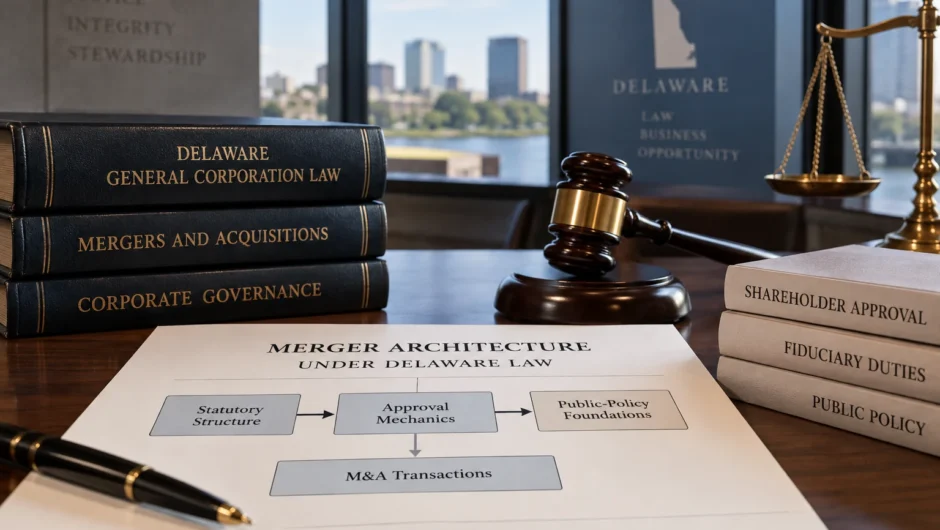
III. Public‑Policy Foundations of Delaware’s Merger Architecture
Delaware’s merger framework is grounded in clear and coherent policy objectives. First, the system seeks to promote efficient deal‑making by preserving contractual stability, reducing regulatory friction, and enabling flexible structuring. The reverse triangular merger exemplifies these objectives by minimizing disruption to the target’s operations and reducing the need for renegotiation of contractual obligations.
Second, Delaware’s merger provisions protect shareholders who bear economic risk by granting them voting rights and ensuring transparency in transactions that alter their ownership. The requirement that target shareholders approve the reverse triangular merger reflects Delaware’s commitment to investor protection in situations involving fundamental changes in corporate control.
Third, Delaware’s jurisprudence reinforces these statutory principles through a series of landmark decisions. Cases such as Revlon, Inc. v. MacAndrews & Forbes Holdings, Inc. and Paramount Communications Inc. v. QVC Network Inc. articulate the fiduciary duties of directors in change‑of‑control transactions, emphasizing the obligation to maximize shareholder value when the corporation is being sold. Decisions such as Lear Corp. and Complete Genomics further refine the permissible scope of deal‑protection measures and clarify the boundaries of board discretion in sale processes. Collectively, these cases ensure that merger structures are used fairly and consistently with Delaware’s policy objectives.
IV. Conclusion
Through its combination of statutory flexibility and robust judicial oversight, Delaware provides a coherent and sophisticated legal environment for mergers and acquisitions. The reverse triangular merger illustrates the strengths of this system: it minimizes operational disruption, preserves contractual and regulatory stability, and aligns with the policy objectives that underpin Delaware’s corporate law. By balancing efficient deal execution with meaningful shareholder protection, Delaware continues to serve as the preferred jurisdiction for structuring mergers and acquisitions in the United States.